On BioScience and Life and Such

Archive for the ‘Uncategorized’ Category

Evidence for Hsp90 involvement in rapid evolution of new traits (chapter IV, blogging in Just Science 08)

In Uncategorized on February 7, 2008 at 10:39 am

Previous posts have attempted to demonstrate that there is a potential role for (Heat Shock) proteins that mask mutations, to enable rapid evolutionary changes. The Hsp90 protein has been presented and the basic problems one face to explain bursts in evolution have been outlined. Now the time has come to show real examples of Hsp90 influencing the evolution of traits.

The following are very short summaries of key papers. For details, please see the referenced papers.

1. Hsp90 and Cancer

In 1993 Yang Xu and Susan Lindquist showed that Hsp90 associates with v-src and inhibits its activity in an concentration-dependent manner. Hsp90 was not merely an on and off switch for v-src, but exhibited transient inhibition, dependent on intracellular concentration of Hsp90. This was a clue to understanding Hsp90’s role in cancer (as well as in evolution). After this, many cancer-related proteins have been identified that interact with Hsp90 (see table).

Table from a review in Nature 2005 by Whitesell and Lindquisthsp90-table-2005-review.jpg

The mechanism one speculates, is similar at the molecular level, to the mechanisms postulated for morphological change. Hsp90 stabilizes the otherwise unstable oncogenic proteins, to aid in tumor growth in an environment hostile to tumor development. In other words: the heat shock proteins protects the oncogenic cells from stress. When the tumor cells subsequently attain further mutations and protein alterations, inherent to oncogenic growth, the heat shock proteins are unable to stabilize all of the altered proteins and the tumor can progress into accelerated growth and/or metastasis. The role of Hsp90 in cancer development has been widely accepted and inhibitors of Hsp90 activity is currently undergoing clinical trials for cancer treatments.

2. Drosophila

The key paper on Hsp90 and Drosophila evolution is the Rutherford and Lindquist paper in Nature 1998. This paper has been mentioned on several previous posts here on SciPhu and also in the introductory Just Science post. Again, the take home message is that reducing levels of Hsp90-activity leads to changes in phenotype. The reason for such dramatic effects is probably that Hsp90 stabilizes proteins that are key elements in intracellular signaling pathways. Often these are kinases, phosphatases or transcription factors, see this table for full list. The common feature of these affected proteins is that they regulate the activity of other proteins downstream in the signaling cascade. Thus, changes in the activity of one master protein acts on the stability and function of many other “executive” proteins ultimately resulting in massive changes. The phenomenon has further been elucidated in other species……….

3. Yeast

In yeast, a reduction in Hsp90 levels potentiates drug resistance and this resistance has multigenic determinants working through Hsp90. Hsp90 thus helps yeast evolve to counter the stressful effect of the drug. Interestingly, this effect is diminished by temperature rise. Increasing the stress (by adding heat) therefore, titrates Hsp90 away from the drug-resistance and makes the yeast vulnerable again (could this effect explain why fever has developed ?).

4. Arabidopsis

Evidence for the same mechanisms occurring in plants comes mainly from two publications on Arabidopsis thaliana (Queitsch C et al. and Sangster TA et al.). These images from the latter publication show the extensive morphological changes seen in the plants.

journalpone0000648g002.png
Figure 2. Similar morphological phenotypes of seedlings with reduced HSP90 function by RNAi or pharmacological means (GDA). (a) and (b): purple pigment accumulation; (c) and (d): organ number defect; (e) and (f): narrowly-shaped deformed true leaves; (g) and (h): twisted rosettes; (i) and (j): lobed cotyledon. RNAi plants are T3 generation with from line RNAi-A3. Size bar 2 mm for b and g–i, 1 mm for a, c–f, and 3 mm for normal phenotype. (b) and (f) originally published in [5].

These effects can also be induced by increasing the temperature. Demonstrating the generality in the stress response. Since the genetics of these plants is easier to trace in these plants than in Drosophila or Yeast, the evidence for buffering genetic changes is even more clear-cut in this organism.

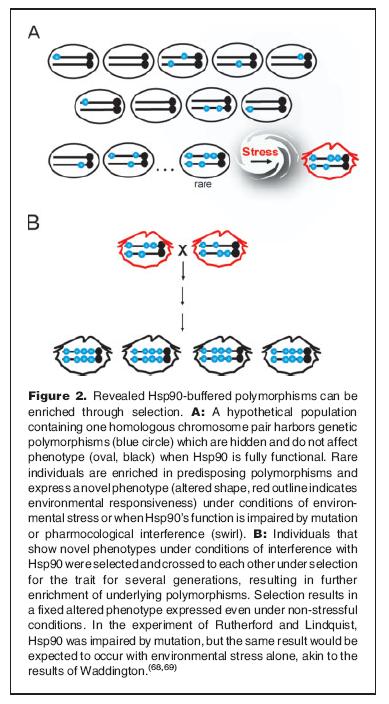
An excellent illustration to summarize Hsp90-buffering comes from Sangster TA et al.:

Hsp90-buffering

In the last post I will present published models on how Hsp90 can act in evolution, – welcome back for the last post in Just Science 08, tomorrow.

How can chaperones act in evolution (chapter III, blogging in Just Science 08)

In Uncategorized on February 6, 2008 at 11:15 am

Moving away from the specifics of Hsp90 for a while, this post shall focus on the general principle of chaperones in evolution. What supports such an hypothesis:

To begin lets look at the problem of rapid evolution. Darwinian evolution is based on a constant rate of random mutations in the genome of any evolving organism. This implies that mutations happens constantly, by chance, regardless of the external environment. Adaptations consequently arise by chance. Evolution of new traits one may think, is therefore slow and gradual.

Gradual evolution

Gradual evolution (reproduced with permission from Dr. Dennis O’Neil)

Since such a view, does not fit with the bursts of evolution observed in fossil material, alternative explanations have been put forward (see more below). However, even when using a constant random rate of mutations one would expect “bursts” or rapid transitions. This is elegantly illustrated in this simulation of an evolving clockwork. Since a beneficial mutation can have a profound impact on fitness, then there should be no surprise that the transition between av less fit form and a more fit one, happens quickly. Thus even with a constant mutation rate one would probably not see a slow, gradual evolution of species, – basic math skills on exponential growth should make this clear. Why this notion of gradual evolution is prevailing I cannot understand.

In addition there are those that believe that the mutation rate may not be constant. Thus, with an increased mutation rate and rapid transitions one can start to explain the observed bursts of evolution.

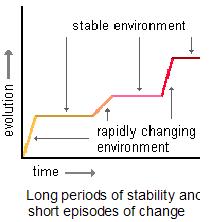
Further explaining bursts of evolution we have the theory of ‘punctuated equilibria’, associated with Niles Eldredge and Stephen Jay Gould, which states that organisms go through short periods of rapid evolution from time to time, against a background of relative stasis (see picture below, and this genomicron post as a starting point for more on punctuated equilibrium ).

Punctuated equilibrium
Punctuated equilibrium (reproduced with permission from Dr. Dennis O’Neil, for his tutorials on evolution go here and here).

This has further led to the theory of hopeful monsters. These theories account for non-linear rapid evolution within the boundaries of Darwinian principles, but they have been heavily criticed. One of the main criticisms of these theories, as far as I can understand, is the improbability of a single mutation to give rise to radical morphological changes, and further that this change, if it happens, is most likely deleterious, and if it against all odds is beneficial, its even more improbable that this individual is able to produce offspring with the same trait(s).

So we are still left with some problems: External environment changes can happen really quickly. Is random mutation events, occurring at a slow rate (even if it’s sped up in larger populations or even if monster are hopeful in times of stress), sufficient to explain the effectiveness of adaptations seen in nature ? Does an organism rely on (slow) random mutations to evolve a trait to help the species adapt to the new environment, or are there additional mechanisms in place to speed up this mutation rate and perhaps guide mutation events towards selected genes that allows rapid changes in phenotypes ?

Enter heat shock proteins…….

The hypothesis is the following: If there is a way to mask (deleterious) changes in proteins under normal conditions, one may accumulate such changes without exposing them.

Hsp90 evolution
Illustration from Sangster TA et al. (more on Waddington will follow in the last post).

Thus, with Hsp90 acting as a buffer: one could potentially get a lot of hopeful monsters, under times of stress, as these traits were exposed. This would drastically increase the chances of a beneficial change to occur at the right time. And since the chance of mating with other monsters with similar traits (there are more than one monster, in fact very many), the chance of keeping the trait(s) in subsequent generations is also increased.

Now missing……..evidence, which will follow in the next post.

Presenting….Hsp90 (chapter II, blogging in Just Science 08)

In Uncategorized on February 5, 2008 at 10:44 am

Chapter I gave an introduction into the role of Heat Shock Protein 90 (Hsp90) in evolution. The main point was its ability to mask/hide transforming mutations until needed in stressful times. This chapter describes its physical and biological properties.

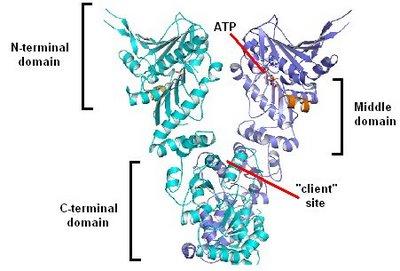
Firstly, what the protein looks like. A really good introduction into Hsp90’s structure is found at the Sandwalk blog. Here’s a picture I stole (with permission) from his blog post on Hsp90:

Hsp90 structure
Picture from: Dollins, E.D., Warren, J.J., Immormino, R.M. and Gewirth, D.T. (2007) Structures of GRP94-Nucleotide Complexes Reveal Mechanistic Differences between the hsp90 Chaperones. Molec. Cell 28:41-56.

From Sandwalk: The complete protein is a dimer of two identical subunits. Each monomer has three distinct domains; an N-terminal domain (N); a middle domain (M); and a C-terminal domain (C). The ATP hydrolysis site sits at the interface between the N and M domains. The C domains interact to form the dimer. The presumed site of binding for misfolded proteins (“client” site”) is in the V-shaped pocket formed when the C domains come together. The mechanism of action of Hsp90 proteins is not known although it presumably involves a conformational change induced by ATP hydrolysis.

Secondly, it’s mode of action. Hsp90 works in concert with many other proteins to form protein-complexes ultimately activating the target protein. The molecular mechanism is as mentioned, still unresolved despite the presence of crystal structures. However, the following illustrations are taken from The Jackson Laboratory at University of Cambridge UK, to depict the overall events:

Model of the activation of a client protein by chaperone machines.
The chaperone Hsp70 system targets the client protein, in this case the steroid receptor, to the Hsp90 chaperone via the organising protein HOP which binds both chaperones. After transferring the steroid receptor to Hsp90, Hsp70 dissociates and is replaced by co-chaperones such as p23 and the high molecular weight immunophilin FKBP52. It is only in this complex that the steroid receptor is activated to bind ligand with high affinity.


And thirdly, which proteins does Hsp90 interact with. Again from The Jackson Laboratory:

 
Hsp 90 and Proteins it interacts with.
The abundant protein Hsp90 is thought to assist in the activation and assembly of specific proteins. Many of these proteins are critical for signal transduction and cell division. As a result, Hsp90 is a target for anti-tumour drugs.

Other examples are: PDK1, PKC-gamma, vSRC/cSRC, PPAR-alpha and p53. A comprehensive list of interacting proteins compiled by Picard Laboratory can be found here.

Thus, looking at all the proteins that can be affected by Hsp90, there is no surprise that the protein is highly conserved and that effects are profound when Hsp90 is fiddled with.

Revolution Evolution (chapter I, blogging in Just Science 08)

In Uncategorized on February 4, 2008 at 10:01 am

My contribution to JustScience 2008 will be a review on a protein with the potential to transform evolution theory as we know it today. The review will be divided into 5 separate blog posts:

1. Introduction to Hsp90 and evolution (this post)

2. Presenting the Hsp90 protein

3. How can chaperones act in evolution

4. Evidence for Hsp90 involvement in rapid evolution of new traits

5. Summary

Here’s the teaser: In one generation you can go from this

Drosophila wild type

to this (a hopeful monster ?).

Hsp90 reduced expression in drosophila
(from Rutherford SL and Lindquist S, Nature 1998
, to see more “monster”-pictures, do a google image search on Hsp90 and evolution)

The protein in focus, Heat Shock Protein 90, is otherwise as normal as a protein can get. It is ubiquitously expressed in all cells and across species, and its function is the same as other heat shock proteins, it’s a chaperone.

A chaperone is a protein that helps other proteins fold correctly (or prevents them to aggregate into non-functional protein junk). Without the chaperone the protein would not achieve an active conformation and end up being degraded. For an excellent video illustrating chaperone assisted protein folding go here.

Caperone illustration
Illustration of chaperones in action. Picture from Nurse Minerva

Now, it turns out that the Hsp90 chaperone function is important for development and evolution of new traits. To illuminate this, the first paper I will discuss is from 1998 by Susan Lindquist’s lab at the Whitehead Institute.

In this paper they take fruit flies and reduce the expression of Hsp90. As I shall come back to later, this is the experimental equivalent to a stressful condition (like for instance high temperature). They can’t knock out Hsp90, because a complete lack of it is not compatible with life (which demonstrates the importance of this protein). When Hsp90 levels are reduced, the fruit flies are born with a number of different defects ranging from defects in the legs and bristles to defects in the eye (see image above). Now, this could be expected when knocking out a protein, but such extensive morphologic changes are not expected from just reducing the levels of a protein (unless maybe if it’s a transcription factor, which it isn’t). The hypothesis explaining this goes as follows……Since Hsp90 is a heat shock protein it is helping other proteins fold. When stressful conditions occur, there will be more proteins that are in need of folding-help, thus some of the proteins that under normal conditions got their help from Hsp90 will now be left on their own. Since, under such conditions, you see these extensive morphological changes, these proteins must be doing something out of the ordinary when on their own, or if they aggregate, their absence causes abnormality. The theory states that these in-need-of-help-proteins must have accumulated mutations that potentially causes abnormality, but under normal conditions they are still able to perform normally due to the action of Hsp90. The implications for evolution are breathtaking since this means that an organism can accumulate a number of mutations and still function normally, but when exposed to stressful conditions, the changes at the protein level are suddenly exposed in their offspring and appear as physical abnormalities. This allows for extremely rapid evolution and could potentially enable a species to change in just a couple of generations.

Illustration of the process and further evidence for this theory will be presented in the next 4 posts the next 4 days, in SciPhu for just science 08.

Next week is Just Science 2008 – week

In Uncategorized on February 1, 2008 at 3:22 pm

Next week is devoted to science only, as I will be posting in Just Science 2008.

Hope many of you will still stop by. I am going to try to write so that the posts will make sense also to those outside of the field. I can’t guarantee though, that everything will be instantly comprehensible as this is dependent on my writing and presentation skills (where there’s definitely room for improvement). Please, do not hesitate to use the comments field for any questions.

The subject of the posts to come will be a mini-review on Hsp90 and evolution. I am grabbing this opportunity to present some scientific evidence for what I believe is the most underrated phenomenon in evolution biology.

On ScienceBlogs 27/-1-08: Quick-Change Evolution

In Uncategorized on January 27, 2008 at 9:46 pm

I have so much to learn, and I’m looking so much forward to learning it. This time around it’s in evolution theory, and I’m going to make some bold statements while learning.

Some recent posts here on SciPhu has been on Hsp90 and rapid morphologic evolution. On ScienceBlogs the topic of the day is Quick-Change Evolution. The background is a blogpost by Olivia Judson stating the return of the hopeful monster. The hopeful monster theory says that extensive morphologic changes in one individual offspring (a monster – an individual organism looking radically different from the rest of its species), sometimes creates beneficial features enabling the monster to create further offspring with similar features. In this way one can achieve rapid evolution (as short as one generation) into the beginning of a new species. The theory is a controversial one and is also called punctuated equilibrium. I however, am apparently at odds with most science bloggers and evolutionary biologists, since the hopeful monster theory sounds plausible to me. How is this linked to Hsp90 you may wonder. Well…

Knocking down Hsp90 creates rapid morphological changes from one generation to the next (for details see references in my previous posts Evolution too fast for our genes to follow, On Hsp90 and morphological evolution and The rate of evolution/mutation/adaptation and future posts to come). Hsp90 does so by masking mutations under normal conditions and then revealing them under stressful conditions. Just to repeat myself, – this concept suddenly made evolution comprehensible to me, and I do not understand why other scientists haven’t embraced the masking concept as a revolutionary concept, expanding darwinian evolution theory.

Now it’s dawning on me why…….Such masking of mutations to produce a pool of potentially crucial mutations gives support to the hopeful monster theory.

One of the main criticisms of this theory, as far as I can understand, is the improbability of a single mutation to give rise to radical morphological changes, and further that this change, if it happens, is most likely deleterious, and if it against all odds is beneficial, its even more improbable that this individual is able to produce offspring with the same trait(s). But…..

Extensive morphological change has been shown to happen due to single mutations, and…

With Hsp90 as a player in the game, it need not be a single mutation, but rather a pool of mutations already present and waiting to be exposed under stress. That increases the chances of achieving multiple changes in multiple individuals. Consequently the chance(s) of producing one or more beneficial trait(s) is(are) increased.

In addition, if such stress appears and mutations are revealed, then many individual offspring will have extensive changes, and the chances for two such individuals to mate increase dramatically.

Thus, I cannot see why a combination of the hopeful monster theory and the actions of Hsp90 (and possibly other mutation masking proteins) under stressful conditions, is a perfectly credible extension to darwinian evolution. An extension that can explain some of the rapid changes that has occured during evolution of species.

A refreshing view on James Watson

In Uncategorized on January 23, 2008 at 12:23 pm

On the Honest Thinking website there is a post that comments on the unison negative response to James Watson’s remarks on race when interviewed by The Independent.

As many will remember the interview created a general outrage and Watson was suspended from his job. There is no doubt that his phrasing was not very delicate, to put it mildly. The subsequent reactions from the politically correct masses were perhaps justified since traces of racism could be found between the lines in his remarks (as well as in previous public comments by Watson).

But, what is the science behind it all ? This popular article shows us that there’s more than one side to this story. It seems that there is solid scientific evidence to support the alleged IQ-difference between blacks and whites. Importantly though, the reasons for this difference is currently not well understood. And even more importantly, genetics is probably only partly to blame.

The way such data is presented is crucial to how it is interpreted and used in a political world. Matters of race awakens strong emotions in us. To avoid misuse of scientific data, it is important to carefully present results concerning race as unbiased and delicately as possible. The motto taken from Honest Thinking: “…….being truthful about whatever one publishes, …….. uncompromising dedication never to suppress relevant data, even when data collides with dearly held prejudices.” is commendable, but fails to account for the presentation itself. The presentation was in this case, equally or even more important than the data, – a lesson hopefully learned by Professor Watson.

10 ways to use your DNA

In Uncategorized on January 18, 2008 at 7:59 pm

Not really news, but for a long time now, I have been meaning to compile a list of different more or less useless DNA-technology applications. Although some may argue that some of these applications can be very useful for the individual, and that some of these sites have yet to reach their full potential, I still think these sites share a general uselessness in improving society.

The list is unsorted.

1. Hairloss. But what difference does it make whether you order a toupée sooner, or later ? Maybe it gives you time to save up for your favorite hairpiece, …….although since you spent your savings buying the test ……..

2. Dogfood. Especially formulated fodder to fit your dogs genetics, – probably including proteins, carbohydrates, fat, sugar, vitamins, minerals and salts – it’s a revolution !

3. Several companies offer genetic testing to optimize your diet and lifestyle. This company and this one are examples. You can also order a genetically optimized juice here and your supplements here. Unfortunately I suspect that the advice we all know already, enough exercise and healthy eating habits, is pretty much the advice these companies are going to give you too. Besides most of us know which foods we tolerate or don’t.

4. Personal genetics from 23andMe, Navigenics and DeCodeMe. This review comments better than I would have, on the health benefits or lack thereof. However, these companies may very well provide very useful genetic information for future research. Whether you should pay $999 for this is another question. Maybe join this project instead ?

5. Genetic ancestry. This is a small industry now. Here, here, here and here are examples. A skeptical news story can be found here. Since Oprah has endorsed these tests, they will prevail, – much like the American presidential election campaign 2008 is settled already, seeing that Oprah has given her support to Barrack Obama.

6. Another emerging industry is paternity testing (examples here, here and here). Actually, this is arguably a useful application for some. Getting knocked up and opting out of abortion, will never be the same.

7. Stretching paternity testing into detecting extramarital affairs however, is definitely not very useful. Is it infidelity you discover or just someones DNA somewhere ? This is the essential question, – usually answered in lengthy court trials and not in any given household.

8. Cosmetics. The following genes will apparently be analyzed in this test: MMP, SOD2, GPX1, EPHX, TNFa. These genes encode proteins central in many cellular processes, not confined to skin cells. Assigning them the responsibility for skin “health” is therefore stretching it. My point is underscored by the fact that the same genes (with some additions) are analyzed in the same company’s…

9. Aging panel (genes: MMP, SOD2, GPX1, EPHX, TNFa, VDR, NQO1, MTRR, MTHFR, PON1, Cyp11B2, ApoB). But if determining aging was this easy then what use are efforts like these.

10. Breeding – DNA-testing is used extensively and increasingly in breeding programmes for livestock and horses. In itself useful I guess, but using this to determine your dog’s breed seem to me to be more on the useless side. Most breeds I know are distinguishable by the naked eye, and usually when you buy a dog from a breeder, the complete ancestry is given. Keeping the ancestry logs and consequently having a pure breed, is what breeders make a living out of.

The first version of this post was published here (not in English).

Metabolomics and the microbiome

In Uncategorized on January 16, 2008 at 12:08 pm

This article from ScienceNow is interesting. When we have characterized the micro organism communities within our bodies, we may start manipulating them into combating disease as well as life style ailments.

At ScienceBlogs: Why don’t they make a birth control pill for men?

In Uncategorized on January 10, 2008 at 8:39 pm

In response to the various answers to this question at ScienceBlogs: Here’s a company that you may find interesting. They are working on a non-hormonal male contraceptive alternative. The drug target is a sperm specific protein that is apparently crucial for motility. Cool if they can make such a drug work, – but even if they can, will men use contraceptives ??

According to this site, – yes, and they even list a number of places where clinical trials are happening (although not for the spermatech drug candidate), – trials you could join presumably, if interested, for some reason or other.