On BioScience and Life and Such

Archive for the ‘Uncategorized’ Category

Warfarin Pharmacogenetics: The Biochemistry

In Uncategorized on November 21, 2008 at 12:19 pm

post to news.thinkgene.com

More in-depth version of the coagulation cascade

Image via Wikipedia

Warfarin (marketed under brand names like Coumadin, Jantoven, Marevan, and Waran) is a drug that inhibits blood clotting – the formation of insoluble fibrin clots which stops bleeding. The drug is used to prevent/treat thrombosis – the formation of blood clots that can cause life threatening damage (through clogging of blood vessels).

Since the natural clotting ability is inhibited with this drug, serum concentrations elevated above the intended level can lead to severe side effects – life-threatening bleeding complications. Consequently, monitoring of patients using Warfarin is critical.

Some patients are at higher risk than others, and pharmacogenetic analysis can identify individuals that are either overly sensitive to the drug or metabolize the drug inefficiently. Both these conditions leaves the patient in risk of complications. Such patients should be monitored carefully and a reduced Warfarin dose is usually strongly recommended.

Metabolism through Cytochrome P450 (Cyp450) enzymes displays individual variation for many classes of drugs, so also for Warfarin. Cyp 450 pharmacogenetics will be covered in a separate post. This post will focus on the biochemistry of oversensitivity to Warfarin which can be described as follows:

Blood clotting is a multistep process involving a number of proteins and co-factors (see image above). Warfarin inhibits the maturation (post translational modification) of some of these proteins, clotting factors II, VII, IX and X. Unmodified, these factors will not function properly and the formation of the insoluble fibrin clot is inhibited.

The post translational modification in question is carboxylation, and it uses Vitamin K as a co-factor
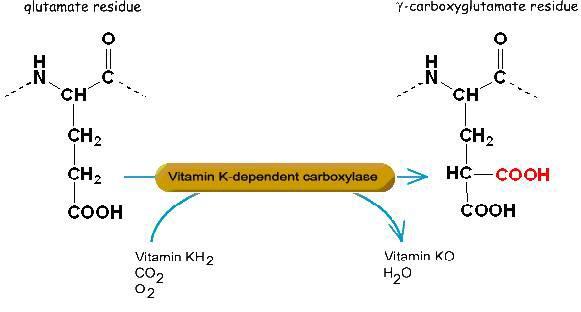
carboxylationimage from: Vita Kbv

Vitamin K is decarboxylated in the process and needs to be recycled. The enzyme Vitamin K-epoxide reductase (VKORC) is essential in this cycle. It is this re-carboxylation by VKORC that is inhibited by Warfarin.
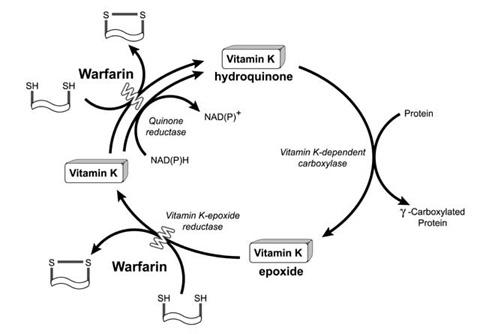
vitamin-k-cycleimage from: Linus Pauling Institute, Oregon State University

Warfarin mode of action summary: more Warfarin leads to less Carboxylated Vit K. Consequently less Factor II, VII, IX and X is carboxylated and inhibition of clotting occurs.

VKORC’s susceptibility for binding Warfarin varies between individuals, and this is the basis for the pharmacogenetic assays. From Wikipedia:

Polymorphisms in the vitamin K epoxide reductase complex 1 (VKORC1) gene explain 30% of the dose variation between patients: particular mutations make VKORC1 less susceptible to suppression by warfarin. There are two main haplotypes that explain 25% of variation: low-dose haplotype group (A) and a high-dose haplotype group (B). For the three combinations of the haplotypes, the mean daily maintenance dose of warfarin was:

  • A/A: 2.7±0.2 mg
  • A/B: 4.9±0.2 mg
  • B/B: 6.2±0.3 mg

VKORC1 polymorphisms also explain why African Americans are relatively resistant to warfarin (higher proportion of group B haplotypes), while Asian Americans are more sensitive (higher proportion of group A haplotypes).VKORC1 polymorphisms lead to a more rapid achievement of a therapeutic INR, but also a shorter time to reach an INR over 4, which is associated with bleeding.

Contributing to haplotype group A is a polymorphism in the regulatory region of the VKORC-gene. The A-allele of this SNP decreases the activity of the VKORC-promoter (less mRNA – less protein – higher proportion of total VKORC protein affected) and subsequently increases Warfarin sensitivity (see OMIM for more). This polymorphism (or ones in linkage with it) is normally among the SNPs that are tested for in the lab.

To conclude, identifying individual genetic variations allow us to predict protein variations that in turn predict sensitivity to certain drugs. In the case of Warfarin such pharmacogenetic analysis can be life saving.

Reblog this post [with Zemanta]

This pisses me off a little

In Uncategorized on November 19, 2008 at 9:47 pm

post to news.thinkgene.com

From this Nature News piece on preimplantation SNP scans of embryos (my highlighting).

[Jacques] Cohen [research director at Reprogenetics, a genetic-testing company in West Orange, New Jersey] says that as the understanding of disease genetics progresses, use of tests that seem controversial now may become more acceptable in the future: “If you had the chance to decrease your child’s risk of a disease like diabetes and you didn’t, society would blame you.

So much is wrong with this statement.

First he is taking the focus away from the very real and disturbing issue of embryo-sorting based on uncertain risk estimation of predisposition to complex disease.

Secondly his statement underscores the importance of the environmental factor in such complex diseases, but it completely misses the point. If you want your children to avoid diabetes, then make them eat right and exercise. You can do that today without any knowledge of their genetics.

Thirdly, currently, society doesn’t seem to blame parents that neglect their children’s health by feeding them unhealthy food or fail to encourage (enforce) physical activity, – why would a genetic test change that.

Lastly, putting such blame on parents has some very problematic socio-ethical issues attached to it.

I hope this is an example of misquoting, I really do….

Update – more on the company Reprogenetics in this post on Sandwalk.

Enhanced by Zemanta

Me: Visible, Traceable, …. Miserable ?

In Uncategorized on November 18, 2008 at 3:07 pm

post to news.thinkgene.com

allelic length variation among 6 individuals

Image via Wikipedia

I am more and more visible. I blog, tweet and use services like friendfeed and LinkedIN. I started out with an alias, but now have my name out there. My picture I anticipate will follow soon. There are services I do not use, – like facebook, – it’s still to “unprofessional” for me (I like my web-presence to be mostly work-related).

As a consequence of this visibility, or more specifically, the subsequent information sharing, I am wiser now as a person than when I started my extended web presence about a year ago. Much wiser in fact. The personal gain has been tremendous.

Work-wise (sic !), we have been planning to set up human ID testing services which would imply creating  DNA-profiles for human identification. Such identification can be used in criminal cases, immigration cases, genealogy research, paternity testing and more.

I realize from learning the nitty gritty of DNA-profiling, and seeing how the technology develops (and becomes cheaper),  that I am (we all are) more and more traceable.

Thus, my body (DNA) as well as my soul (web-presence), is now out there for everyone to see

The big question then becomes: Is this virtual hereditary omnipresence dangerous to me ? Are we approaching George Orwells Big Brother scenario ?

I (maybe naively) say no, it is not dangerous. Because, to some extent I still choose when to be present on the web and to which groups I am visible. And, If I choose not to do illegal acts, – and If the system works the way it is supposed to, I would be kept out of any DNA-profile registry (if my profile is not registered, then my identity is not revealed by my DNA, and I can retain my anonymity).

If I end up in such a registry because I am falsely accused of something, or framed……or if someone decides to do a SNP scan of me without my knowledge……..or if my web-identity is misused……now that’s a different ballpark altogether, and I’ll try and explore the danger that lies in such abuse in future posts. Fact is though, in these cases we are talking about abuse and abuse is “dangerous” in any setting.

For now I’d like to make a point to the contrary: At least when it comes to sharing personal info on the web: It could in fact turn out to be damaging to my future career and reputation not to do it. Damaging, because web-sharing is rapidly becoming the norm (pointed out by Bora Zivkovic on friendfeed):

Exactly! 20 years from now a person who does NOT have drunk Facebook pictures online will be suspicious – what was there to be whitewashed? or is this person too timid or antisocial?

Nevertheless, I still choose not to sign up on Facebook since anyone valuing my personal life higher than my professional one when hiring is not worth working for.

And that’s just it, even if I’m being naive about this, I still have a choice not to share, – and as long as that choice is a free one, then there should be no reason to sound the big brother alarm.

Enhanced by Zemanta

I’m not sure why I blog

In Uncategorized on November 17, 2008 at 10:19 am

But I suspect maybe:


HOPE


(Which, I figured, is also the politically correct and trendy answer……..and……….there is poetry in it’s simplicity)

Syncroblogging link

Enhanced by Zemanta

A Three Stage Program to Become an Open Access Fundamentalist

In Uncategorized on November 13, 2008 at 2:51 pm

post to news.thinkgene.com

I must admit that I am not a fundamentalist myself, nor am I sure I will ever become one. But I try to advocate open access, and as much as possible I follow the first two steps below. In addition, I have set up a free site for anyone to publish according to step 3 which is sciphu.com (but any site will do…..ideally one using widely accepted publication identifiers – sciphu.com isn’t…yet).

Following the recommendations in step 1 and 2 makes you a supporter and Open Access activist. Following recommendations in step 3 will make you a full-fledged Open Access Fundamentalist…….

1. Supporter stage. Openly support initiatives like PloS and contribute to activities like Open Access day.

2. Activist stage.

a) Publish in Open Access journals as much as possible.

b) Mail authors for reprints. Whenever you need an article published in a pay-for-access journal, write to the corresponding author asking for a reprint. Even if you have access through your institutional subscription (or get it through friends and colleagues), write the author to notify him/her that the paper is not open access. This increases awareness….

3. Fundamentalist stage. Send in your paper to be peer reviewed like you normally would (preferably to a pay-for-access journal). Receive your reviewer comments, edit according to those comments, but do not send your manuscript back to the journal. Rather, publish on freely accessible web page. Include the peer-reviews if you want, but clear this with the reviewers first.

Image by asher taken from Elephantitis of the mind

Enhanced by Zemanta

Uses of DNA nr. 22-26

In Uncategorized on November 11, 2008 at 11:47 am

post to news.thinkgene.com

Animation of the structure of a section of DNA...

Image via Wikipedia

This post follows previous posts 10 ways to use your DNA, 9 more ways to use DNA and Add this to the “uses of DNA” collection.

22. Find invading species in your garden pond. You may need some help to design the assay (species specific primers and probes). But from there it’s a straightforward road to eradicating unwanted organisms that you were unable to see.

23. DNA art made from genes possibly contributing to athletic skills, intelligence and love (??!). See Eye on DNA’s blog posting about the offer from DNA 11 (coincidentally, this is also a follow up to use of DNA nr. 11).

24. Clone your dog – two companies can offer cloning of your dog: BioArts and RNL Bio. The two companies have been arguing (like cats and dogs !) however, over who owns the rights to such cloning.

25. Make a quilt using DNA sequence. Artist Beverly St. Clair makes quilts where each patch corresponds to one of the four bases in DNA. Beautiful and intelligent at the same time …..

Picture from genomequilts.com by Beverly St. Clair. It depicts the DNA sequence GATCGCCCTT

26. Poo-ID. The Israeli city of Petah Tikva has decided to do something about their dog poo problem. The solution: create a DNA profile from the poo and then, find the owner in a registry of dog-DNA. See here for more info.

Reblog this post [with Zemanta]

Tests that make me cry, and stealing too !!

In Uncategorized on November 7, 2008 at 4:45 pm

post to news.thinkgene.com

This company (DNA Dynasty) must burn. First for stealing the logo from The DNA network:

dna-dynasty-dna-network

But, more importantly they must burn for doing what they do – from their blog (my highlights):

Dr Y.M Wong, who runs an anti-ageing management practice at Paragon Medical Centre, is a doctor who recommends his patients to DNA Dynasty to complement his treatment. “My patients are put on a stricter programme for disease-prevention if they are discovered to be susceptible to a certain gene,” he said. According to the firm’s flyer, the Genetic Discovery Test can identify up to 33 genetic traits, such as intelligence, emotional quotient (EQ) and entrepreneurship. Some, like businessman Lau, 44, have sent his kids for the Genetic Discovery test to “save money”. He said: “Now I know my one-year-old will be good at business. He has high EQ and leadership skills. “My older child, who’s three, will be good in science and can perform well as an engineer. With this knowledge, I know how to develop their talents without wasting time sending them for different enrichment programmes.

And burn to the ground….since, in response to this:

Dr Andy Miah, a bioethics lecturer at the University of Paisley in Scotland and the author of Genetically Modified Athletes, told The Times: “By using gene tests for sporting aptitude, children might be dissuaded from sports they enjoy, simply because somebody has decided that they will never be a great performer.”

They answer:

Yet Ms Sally Soo, managing director of DNA Dynasty, remains unfazed. She said: “It’s been proven that Jamaican runners are faster than their counterparts of different nationalities because of their genes. “I believe that a 1-per-cent variation makes a world of difference between two people.”

In lack of words, I’m weeping for the future of responsible medical genetics.

Reblog this post [with Zemanta]

DTC-testing concluded for now

In Uncategorized on November 6, 2008 at 11:15 am

post to news.thinkgene.com

{{es|The Doctor.

Image via Wikipedia

A lot has been said about (and argued over) Direct To Consumer (DTC) testing. For extensive coverage of the pros and cons of regulation of such genetic testing please go see The Gene Sherpa and Genetic Future (also, check out a number of recent papers in Nature, – to find them, go read the relevant posts at The Genetic Genealogist or Genetic Future). I have voiced opinions on this too, but have decided to desist more arguing (for a while) after reading this editorial in Nature biotechnology:

1. We need to move from late to early diagnosis

It is virtually impossible to conceive of a sustainable form of healthcare that operates as the current systems in industrialized nations do. At present, healthcare is based on the late diagnosis of disease and the division of diseases into a few categories based on some overarching gross similarities. And it firmly places physicians as the central gatekeepers of information.

2. To do this we need find ways to utilize the potential unleashed by large scale analysis of genetic-material.

The healthcare of the future, on the other hand, if the technical potential to provide personalized medicine is ever to be realized, will probably require a greatly expanded emphasis on diagnosis and monitoring, early and subtle intervention, monitoring of the impact of intervention, and gradual adaptation of treatment with the evolving physiology, metabolism and lifestyle of the individual.

3. But, the medical professionals and healthcare systems do not currently have the capacity to adequately respond.

Faced with this huge expansion of data on ‘my’ health, it will simply not be affordable to maintain our dependence on medical gatekeepers, whether they are physicians or genetic counselors, without individuals taking a much greater responsibility for their own wellbeing. Whether the medical establishment likes it or not, it will be too cumbersome and too expensive to conduct personalized medicine if all diagnostic-to-therapeutic decisions depend on doctors.

4. Therefore, In order to adapt to this new situation, we need to find the golden mean between no regulation and over-regulation.

For personal genomics not to be stillborn, the medical community and regulators thus need to reevaluate their role as gatekeepers. Clearly, they need to be involved in the medical actions that might follow as a consequence of genetic or other diagnostic testing. And for any gene test, regulators must ensure that companies make claims to consumers that are both truthful and accurate. But simply shutting down the whole direct-to-consumer gene testing enterprise because it departs from the traditional genetic testing paradigm of doctorordered test will both retard progress and stifle investment in more advanced whole-genome sequencing technologies—technologies that have the potential to ultimately deliver the promise of genomedirected medicine.

Regulation is obviously needed at some level. However, I reside in a country where regulation completely stifles any attempt to do personalized medicine, even at the most innocent (Cyp 450) level. I strongly advise against such an approach. Transferring all testing currently offered by DTC companies, to existing health-care programs will flood the system, and hence is not an option either.

In my opinion, there is an imminent need to define the subgroup of genetic tests that needs to be accompanied by counseling/medical advice. Group those out sensibly, grade them according to counseling importance, and you have a solution.

Enhanced by Zemanta

Quote of the month November 08

In Uncategorized on November 4, 2008 at 9:58 pm

Deepak at business|bytes|genes|molecules, on open access publishing (my highlighting):

Everyone should have access to the same scientific information (what that information should be is the subject of another post). It’s not even about who pays for it. It is science, and as such belongs to everyone.

Enhanced by Zemanta

U.S. citizens: Happy voting

In Uncategorized on November 3, 2008 at 1:51 pm
Barack Obama speaking in Houston, Texas on the...

Image via Wikipedia
